|
|

|
  

5/4/2026
WT Staff
 Got water questions? Got water questions? Give us a call at 877-52-WATER (877-529-2837), or email us at info@wtny.us
This waterless separation technology produces some of the best graphene and strongest composites. Will the graphite industry retire water intensive flotation processing and embrace a new process?
Interview with V-Bond Lee, President, Chairman and CEO of
Volt Carbon Technologies Inc.
May 4, 2026 447 pm EDT
Edited for clarity and length
WT: Thanks for being here. We met at your exhibit at the Prospectors and Developers Association (PDAC) meeting beginning of March (2026). A big event, organizers say 32,000 attended, did you have a lot of interest?
V-Bond Lee: Yes, one of the biggest shows in recent years. We had a lot of leads, there is a lot of interest in lower cost methods, methods that are quicker to market, are simpler, and methods that actually extract the high grade ore as opposed to homogenized volume ore and then try to extract from there. So our process seems to fit with the demand in graphite.
A bit of background on graphite, from Natural Resources Canada:
"Graphite is a non-metallic mineral that has properties similar to metals, such as a good ability to conduct heat and electricity. Graphite occurs naturally or can be produced synthetically. Purified natural graphite has a higher crystalline structure and offers better electrical and thermal conductivity than synthetic material. It is also an essential material in electric vehicle (EV) batteries, where it is used to make the anode—the part of the battery that stores and releases energy. In fact, graphite is the single largest component in a typical lithium-ion battery by weight, making it a key ingredient in powering EVs."
The core components of graphite ore processing includes crushing, the flotation circuit, followed by dewatering to recover the target material.
WT: Can you tell us more about selective vs homogenized volume ore processing?
Lee: When we look at areas of ore that are 1, 2 or 3%, we don't really want to go after that. For every hundred tons of material, we have 97 tons of waste and 3 tons of goods. One thing we are very attentive to, we would rather process an ore material with 20% grade. Then you are throwing 4 tons back for every 1 ton of goods. Big difference in operational cost, absolutely. Just by the numbers.
WT: Is the technology for extraction of different target metals, or are you focused on graphite?
Lee: We are focused on graphite, but we also have a mineral property in BC, called Mount Copeland, and it contains moly. We were able to dry-extract moly to concentrate, which is pretty interesting, because not many people have done that. We also discovered a few other things, rhenium, existing with the host, moly. Rhenium is one of the most critical materials for defense, because of its ability to enhance the performance of metals. It's not classified as rare earth with all governments, but it is quite rare. It appears at .7 ppb in the earth's crust, so anywhere it is concentrated in higher quantities, like we found, 3000 ppm, is a plus.
At Mount Copeland, the moly appears to exist in nodules, so that's where we are thinking of applying a robotic separation process. We can actually go after a vein in the deposit, as opposed to digging everything out. That's our plan for that area. There's not a lot of robotic mining around, that I know of right now, especially the way we are planning, looking at it.
WT: We initially approached you about the dry extraction process. How did you come upon this method of waterless extraction? Is it proprietary?
Lee: Yes we just received our third patent notification for the dry separation process, we got the allowance last week. It is an air classification system that separates minerals based on density, particle morphology, and aerodynamic behavior under controlled airflow. The gist of our patent, that graphite flakes and spins differently. It's got some aerodynamics capabilities. When we float the material through our air box, we are able to collect flakes of graphite rather than using a water slurry.
A paper published in the International Journal of Chemical Engineering, March 21, 2023 A Mini Review on Flotation Techniques and Reagents Used in Graphite Beneficiation by N. Vasumathi et al, says:
Due to its numerous and major industrial uses, graphite is one of the significant carbon allotropes. Refractories and batteries are only a couple of the many uses for graphite. A growing market wants high-purity graphite with big flakes. Since there are fewer naturally occurring high-grade graphite ores, low-grade ores must be processed to increase their value to meet the rising demand, which is predicted to increase by >700% by 2025 due to the adoption of electric vehicles. Since graphite is inherently hydrophobic, flotation is frequently used to beneficiate low-grade ores."
From MiningPedia.cn, "After crushing and grinding, the next step is to separate graphite from other impurities, such as quartz, mica, and feldspar. This is done through various beneficiation techniques, (including):
Froth Flotation: The most common method of separating graphite from other materials. In this process, the crushed ore is mixed with water and chemicals that cause the graphite to float to the surface, where it is skimmed off." Mechanical froth flotation, column flotation, ultrasound-assisted flotation and electroflotation use a significant amount of water. Some operations are recycling the process water in a closed loop system, reducing the total volume required for multiple floats to process a single batch of crushed ore.
Back to the interview
WT: Is Volt actively mining graphite, do you have your own mines in operation?
Lee: We have recently acquired some mineral tenures in Quebec, which we are exploring. We prefer to partner with (existing) graphite mines and supply the extraction technology.
WT: Do you have to break up the ore with your air classification process, or can it go in fairly large chunks? How does it work?
Lee: We use controlled, low energy crushing designed to preserve flake integrity. The graphite flakes are sort of fragile. Graphite does not have a lot of shear resistance; if I picked it up in my fingers, it would smear, like pencil lead. When we crush the ore in a very strategic way, we liberate larger flakes of graphite. Large particles will sit on the (30-mesh) screen and the finer particles of sand, silica, feldspar fall through. The product is ready to use from here.
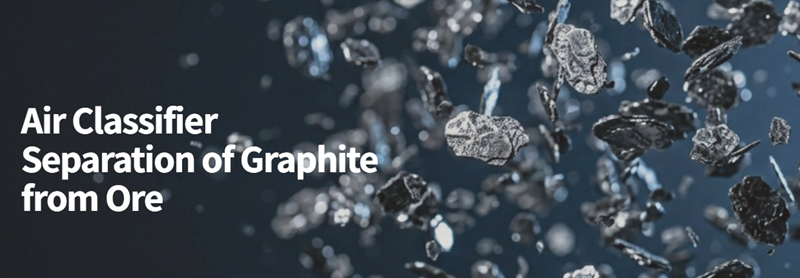
Air lifts graphite flakes in Volt Carbon Technologies dry separation process
I was recently looking at a few graphite operations. They crush the ore so much, they are not able to recover graphite in the size of flakes the way we do. With the flotation method, you have to dry the slurry with extra processing, at extra cost. The cost per ton is higher, and the consumption of water is substantial.
This is pretty much what we do: from the fact that we don't over crush, we really preserve what others destroy. The conventional method of extraction damages the crystallinity. The unique proposition we have, is we found crystallinity is the gateway to the higher value carbon materials, including graphene. We are able to get graphene out of this, the graphene becomes very valuable. The quality has been strong, and based on our internal characterization and early testing, we believe it is competitive with leading graphene approaches. In our materials strength, we have had some of the highest numbers in the literature.
WT: Graphene is a single layer of carbon atoms, is that right? Is it the case that the larger particle size of graphite flakes goes along with a higher strength graphene?
Lee: Yes. With the larger (graphite) flakes, I can actually extract large sheets of graphene. The larger the sheet, the higher the strength in the composites. That's been proven. Most graphene applications reported in literature show strengthening in the range of approximately 20 to 30 percent. In our internal composite testing, we have observed improvements of up to approximately 60 percent. Our view is simple: if the graphite feedstock is right, everything downstream, from anodes to graphene, becomes more efficient and higher performing.
WT: What sort of equipment, machinery or technologies are constructed with graphene, and why does the extra strength matter?
Lee: Graphene is one of the strongest materials on the planet. It has to be encapsulated in the lattice (formation), and it's got to be functionalized so that it actually grabs on to other chemistries. We create this variant called reduced graphene oxide, it is about five layers of graphene. It is functionalized in oxygen groups. When we mix this in with epoxy, it becomes kind of like a composite material already. The epoxy is the glue that binds carbon fiber together. In an aircraft, you have epoxy binding carbon fibers to make the wings, for example. We can make the glue stronger by 60%, so you now have a structure that is so much stronger than the baseline.
WT: Are these concepts coming across at the mines, at the extraction level? How is the adoption going?
Lee: Adoption, I can honestly say, has been slower than expected. The traditional method has been out there for many years. There are a lot of metallurgists and processing engineers that are used to going through six or seven steps of flotation to extract graphite. They are stuck to the tried and true, which is okay. I've also been out there, I guess now 6 or 7 years in the shop, getting my elbows dirty, and successfully extracting the same type of material, but in a much better quality. In my view, as we can extract the material and manage the dust, I think it is absolutely doable. Our process will prevail.
WT: We initially approached you about the water-saving aspect of your extraction process. You say the quality is higher, and the cost is also significantly reduced, on your website, you say 5 to 10 x lower cost. Are you getting your message out globally?
Lee: We are talking to owners of mines and deposits around the world, and we have tested a lot of graphite rock. The best ore (flake graphite) grades are actually in Canada. We have done a lot of work in Quebec and Ontario, so we are trying to strategically align ourselves with investors in Quebec and Ontario.
WT: Have you encountered anyone else doing similar? What was the genesis of this?
Lee: No, nothing similar. When I became CEO a couple of years ago, we already had the air classifier process, but at the time, it was not patented and was not developed the way it is now. I had to redesign a lot of the equipment. Coming from an aerospace background, I was able to use aerodynamics and utilize some of our aerodynamics experts to fine-tune the process, and also apply for patents.
WT: What is your background, your formal education and experience?
Lee: My background is in Mechanical Engineering. I have been in the industry 38 years. I've spent about 15 of it in automotive, another 15 in aero and nuclear. I am a bit of an inventor, I have about twenty patents out there, some of them have been commercialized. I always have about ten patents on the go. I have ten on the go now, six being published and examined, and three or four that are close to allowances.
WT: Can I ask about finances? Have you attracted the investors you need to mobilize this technology?
Lee: Here is an interesting thing. In my own abilities, I feel very confident. In my past career, some of the patents I have worked on have made substantial revenue for companies. I know, I am confident with what we do, engineering-wise. When I inherited this company, the management part had done some things that were not very professional, let's just say that. It has taken this company a little while to recover, as there was damage done to the investors and damage done to the reputation. It is part of my bucket list to take a company that required significant rebuilding in both operations and market confidence, turn it around and create value. I am taking a very professional approach. In our organization, we push a lot of ethics. I come from aerospace, ethics mean everything to us. The way we behave, the way our people operate, that's what makes a company valuable.
So we are starting to build that (trust), we are starting with small contracts here and there with OEMs, even in our battery plant. So, I think we are well on our way. In answer to your question about investors, yes, it has been difficult. Have I got any grey hair? Yes, because at the end of the month, its always about people and equipment. They come first before myself. Our priority has been rebuilding the organization around people, equipment, and disciplined execution. In the last five years, we have raised about $8 million dollars. Some of it was just to clean up the past status of the company, some was to build equipment, to build a lab. I actually have a plant in Guelph that builds lithium-ion batteries now, along with working on this processing. To date, revenues have been project based and modest, as the Company has focused on process development and validation. We are now working toward transitioning into commercial deployment.
WT: So you are largely looking for more graphite properties around the world that you can walk in and save operating cost, save a lot of water use, and get a better, stronger product?
Lee: Yes, I think that will be our brand, is to have novel equipment that can do the job with less harm to the environment.
WT: What does the capital investment look like compared to the traditional float way of doing things?
Lee: The way we pitch this, We are targeting approximately $7.5 million to $15 million for a demonstrator facility in the range of 250 to 750 tonnes per annum, intended to validate the process at scale and support commercial partnerships. So, that's the pitch deck we have with a lot of investors, including some of the government funding agencies that we are working with right now. I'm looking to raise not just survival money, but money to actually get this done, to drive a revenue stream. From there, the pathway to graphene, nobody has the crystallinity, the quality of graphene we can create. That in itself is another multi-billion dollar market.
Our revenue model is a 50:50 processing model, we split the profits. Carbon credit modeling suggests the potential to materially offset operating costs, subject to verification and market conditions. There can be no assurance that these offsets will fully cover production costs. Not only are we saving the risk of acid mine drainage, we are also able to provide a process where there is enough recognition that carbon credits covers the cost of production. We are not trying to improve the existing system. We are aiming to replace it with something simpler, lower cost, and fundamentally better for both the environment and downstream performance.
Globe and Mail article of Tue Apr 21, 8:22AM CDT
Volt Carbon Receives Third U.S. Patent Allowance Strengthening Dry Separation Platform for Graphite Processing
Calgary, Alberta--(Newsfile Corp. - April 21, 2026) - Volt Carbon Technologies Inc. (TSXV: VCT) (OTCQB: TORVF) ("Volt Carbon" or the "Company") is pleased to announce that it has received a Notice of Allowance from the United States Patent and Trademark Office for U.S. Patent Application No. 18/823845. This represents the third patent allowance arising from the Company's original filing, establishing a growing patent portfolio that protects Volt Carbon's proprietary dry separation technology and its application across graphite processing and advanced carbon materials. With this milestone, the Company continues to establish a defensible foundation for its dry separation platform as it advances toward commercial deployment.
Volt Carbon Technologies (TSX:VCT) Stock Overview
A junior resource company, acquires and explores mining properties in Canada.
Snowflake Analysis: Adequate balance sheet with slight risk.
Rewards: Earnings have grown 23.8% per year over the past 5 years
Risk Analysis: Does not have a meaningful market cap (CA$8M), makes less than USD$1m in revenue (CA$10K)
Highly volatile share price over the past 3 months compared to the Canadian market
See WT article, DEVELOPING CANADIAN MINERAL SUPPLY TO THE GROWING ELECTRIC VEHICLE (EV) INDUSTRY, SANS WATER AND CHEMICALS, here.
|
|
|
|
All rights reserved 2026 - WTNY - This material may not be reproduced in whole or in part and may not be distributed,
publicly performed, proxy cached or otherwise used, except with express permission.
|
|
